


Before buying a SUP there are three questions: inflatable or hardboard, which size and which type? Here’s the honest comparison , no invented test badges, but clear recommendations on which board suits which use. If you then want to go deeper, the SUP buying guide helps.
Inflatable (iSUP) or hardboard?
| Inflatable (iSUP) | Hardboard | |
|---|---|---|
| Transport & storage | in a backpack, fits anywhere | needs space & roof rack |
| Durability | very tough, bounces off | more delicate (dings) |
| Ride feel | great all-rounder, a touch softer | more direct, faster, better in waves |
| Effort | pumping up (5–10 min) | ready to go instantly |
| Entry price | cheaper, usually as a complete set | tends to be pricier |
| For whom? | the vast majority , beginners, family, touring, travel | ambitious riders, waves, if you have space |
Verdict: For the vast majority , and especially on the Baltic with changing spots , an inflatable iSUP is the more practical choice. A hardboard pays off mainly if you specifically want to ride waves or seek the direct ride feel and have the space.
Which size? By body weight
What matters is the volume (in litres) relative to your weight , the more volume, the more stable. Guide values for an all-round iSUP:
| Body weight | Volume (guide) | Length (all-round) |
|---|---|---|
| up to 70 kg | from approx. 240 l | approx. 10’0″ – 10’6″ |
| 70–90 kg | approx. 260–290 l | approx. 10’6″ – 11’0″ |
| 90–110 kg | approx. 290–320 l | approx. 11’0″ – 11’6″ |
| over 110 kg | from approx. 320 l | 11’6″ and up, wider |
Which type , which board for what?
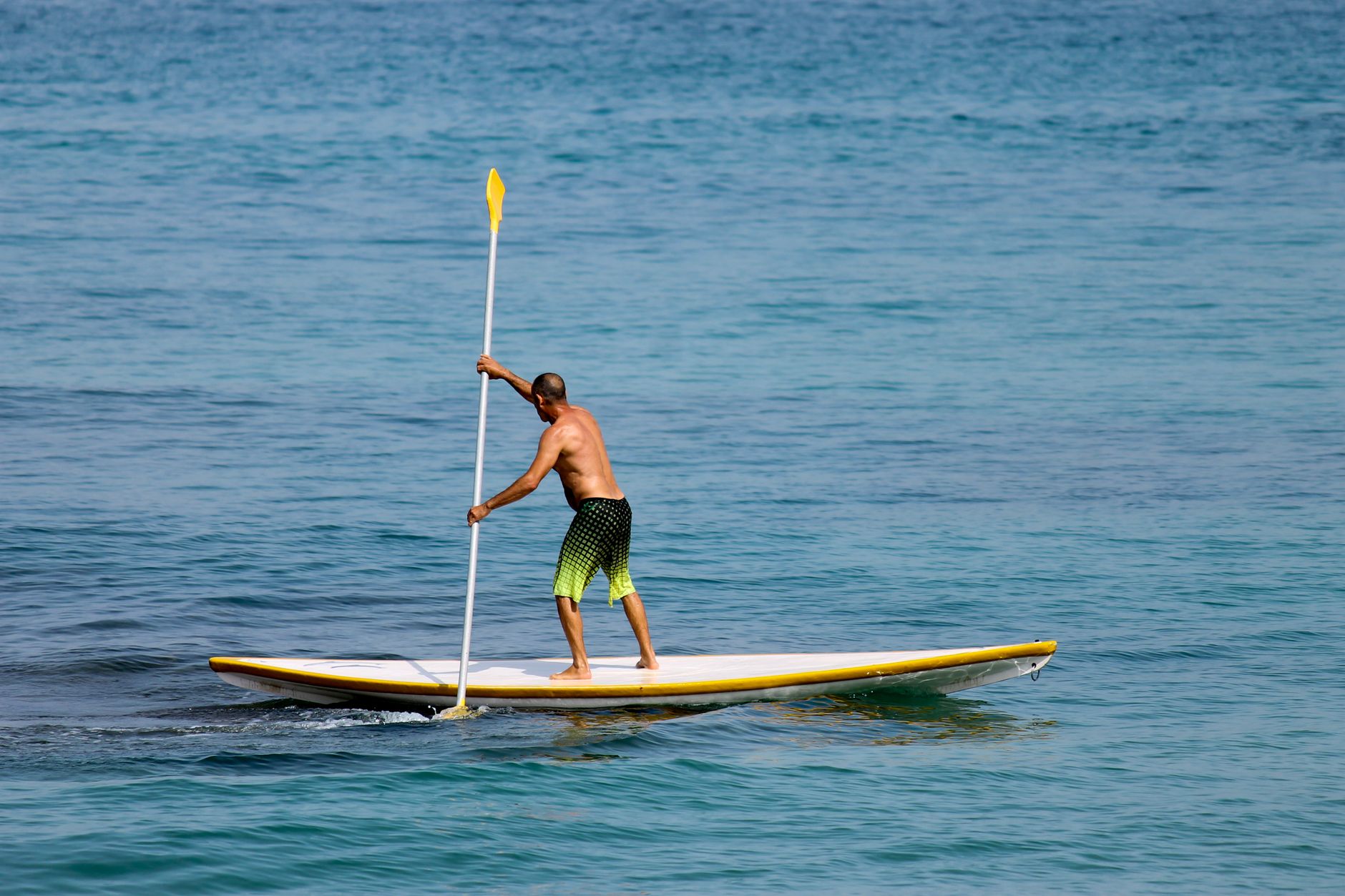
- All-round: the beginner classic , wide, stable, for flat water, touring and family. The best first choice.
- Touring: longer and pointier, tracks better in a straight line , for longer distances and calm bay tours.
- Wave/surf SUP: shorter and more manoeuvrable , for the Baltic wave on good days, but wobblier on the flat.
- Race: narrow and fast , only for the ambitious, too tippy for beginners.
What to look for in an iSUP
- Stiffness: double-layer or fusion drop-stitch material is much stiffer (and lasts longer) than simple single-layer.
- Pressure: it should take at least 15 psi , the stiffer, the better the ride.
- Set accessories: a good iSUP comes with a paddle, double-action pump, leash, fin and backpack. Look for an adjustable, not-too-heavy paddle.
- Fin system: a click or US box beats a screw fin for convenience.
- Weight limit: mind the maximum load, especially if a dog or child comes along.
What should it cost?
Rough guide: beginner sets start at around 250–350 €, a solid mid-range with better material and accessories is about 400–700 €, premium above that. Steer clear of the very cheap offers under 200 € , wobbly material spoils the fun. More on renting, buying and saving in What does a SUP cost?.
Safety: vest & leash
In some countries a buoyancy or life vest is mandatory for SUP , in Denmark a SUP counts as a vessel depending on the water, and a vest is expected on open water. Check the local rules before your tour. A leash is always part of the kit anyway , it keeps you together with the board when the wind picks up.
In short: the right SUP
- For most: an inflatable all-round iSUP.
- Size by body weight , as a beginner, more volume and width.
- Look for stiff material (double-layer/fusion), a good paddle and set accessories.
- Hardboard or wave SUP only if you specifically want waves.
- Avoid bargain-basement boards under 200 €.
Note: as soon as our shop and partner links are live, you’ll find concrete board recommendations per category here. Until then: the content stands on its own, even without a single click.
Downwind , the 2026 trend
A fast-growing trend is downwind: gliding open stretches on wave and swell, driven by your paddle , increasingly on the foil (SUP foiling). There are special long, narrow downwind boards , a selection is in the hardboard overview. For advanced riders and pros.