


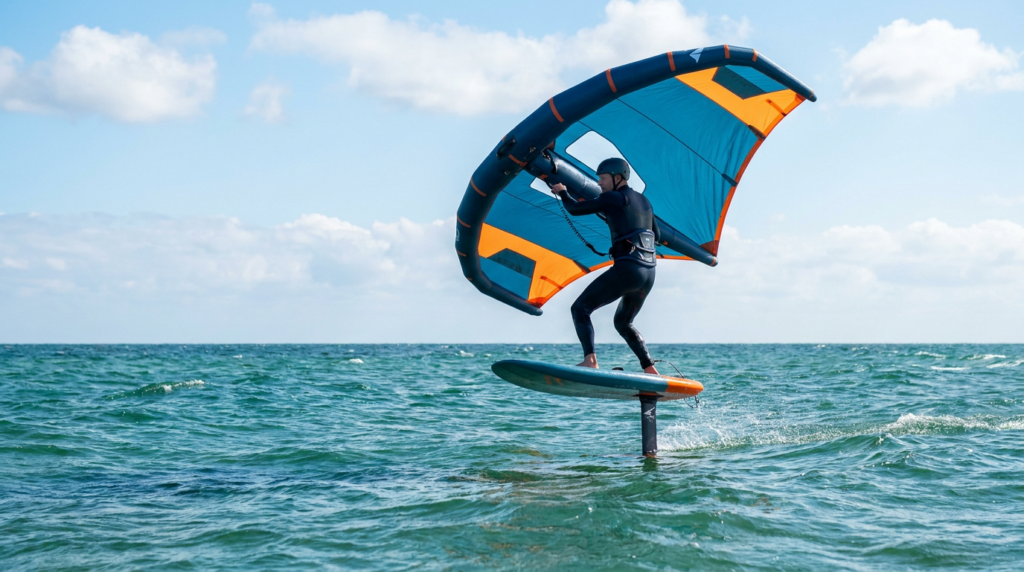
Wingfoiling is the fastest-growing watersport, and one of the most accessible. But the wingfoil gear for beginners can be confusing at first: wing, board, foil, plus a load of numbers. Here is the honest take, without the jargon, on which sizes really fit, what it costs and what matters when you start. This is a buying guide, not a paid test.
The three parts: wing, board, foil
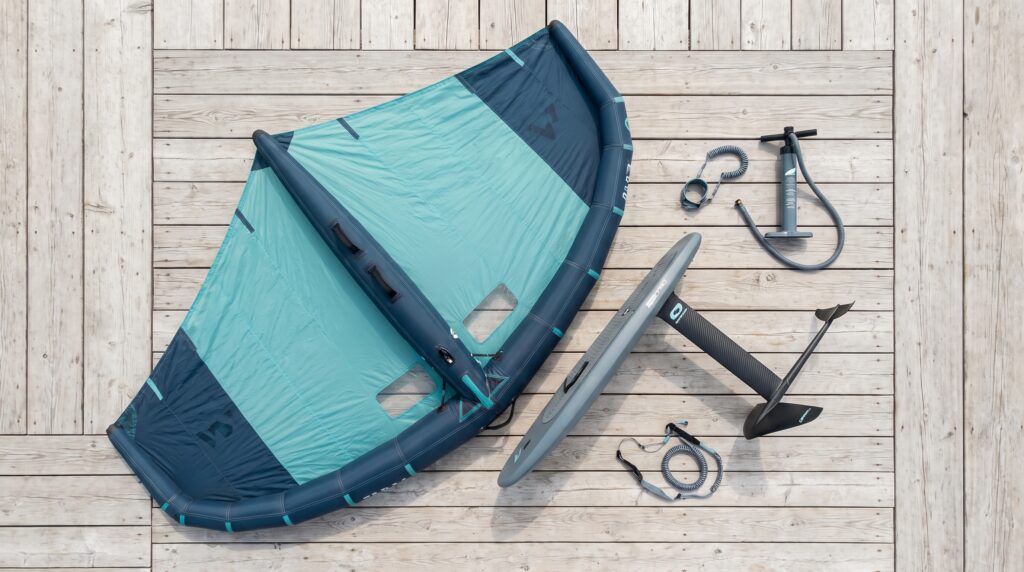
A wingfoil set consists of three components: the wing (the handheld sail that powers you), the foilboard (the one you stand on) and the foil (the wing under the water that lifts you off). On top of that come a pump, leash and wetsuit. For beginners the same principle applies everywhere: rather a bit bigger and more stable than too sporty.
Which wing size do you need?
A 5 m² wing is the best all-round size to start with, it covers most conditions on the Baltic. Heavier riders or light wind, then more like 6 m². Only once you ride confidently and the wind blows harder is a smaller wing worth it.
| Condition | Wing size |
|---|---|
| Light to normal, medium wind | 5 m² |
| Heavier or light wind | 6 m² |
| Strong wind (later) | 4 m² |
First purchases with examples by body weight
The simple rule of thumb for real beginners: body weight in kilos plus 40 gives the board volume in litres. More volume means more buoyancy, you stand more stably and practise more calmly. Better a few litres too many than too few, you can size the board down later.
And so you do not have to guess, here is the complete first kit by weight, deliberately chosen a bit bigger and more stable so you get results faster. Brands measure their foils slightly differently, so take the numbers as guidance, not as law.
| Body weight | Board volume | Front wing | Stabilizer (back wing) | Mast | Wing (sail) |
|---|---|---|---|---|---|
| approx. 45 kg | approx. 75–85 L | approx. 1200–1400 cm² | approx. 180–200 cm² | 70–75 cm | 3.0–3.5 m² |
| approx. 65 kg | approx. 95–105 L | approx. 1500–1700 cm² | approx. 230–260 cm² | 72–80 cm | 4.0–4.5 m² |
| approx. 85 kg | approx. 115–125 L | approx. 1800–2000 cm² | approx. 280–320 cm² | 75–82 cm | 5.0 m² |
| approx. 100 kg | approx. 135–145 L | approx. 2000–2400 cm² | approx. 320–360 cm² | 80–85 cm | 5.5–6.0 m² |
On the mast: On the shallow Baltic you ride more comfortably at first with a shorter mast (70 to 75 cm), you do not hit the bottom straight away and falls are gentler. Once you fly confidently, a longer mast (80 to 90 cm) gives more room in waves and at height. On the stabilizer: it usually comes matched to the front wing, a slightly larger back wing makes the foil calmer, exactly right for learning.
Which foil?
With the foil, what counts is the area of the front wing. A large front wing of around 2000 square centimetres (range 1800 to 2500) lifts off early, rides even in light wind and forgives a lot. That is exactly what you want at the start. Small, fast foils come later, once you fly confidently.
Hardboard or inflatable board?
Both get you onto the water, they just feel different.
| Advantages | Disadvantages | |
|---|---|---|
| Inflatable | Soft falls, very robust, packs down small, easy to transport, usually cheaper | Flexes a little, less direct, thicker, quickly “outgrown” as you progress |
| Hardboard | Stiff and direct, more efficient, faster progress, thinner and more controlled | More expensive, more sensitive to dings, bulkier transport, harder falls |
Our recommendation: If you just want to try it out, without a cellar full of boards and with soft falls, an inflatable is ideal. If you already know you will stick with it, and you have room for a hard board, a high-volume hardboard moves you forward faster and stays with you longer.
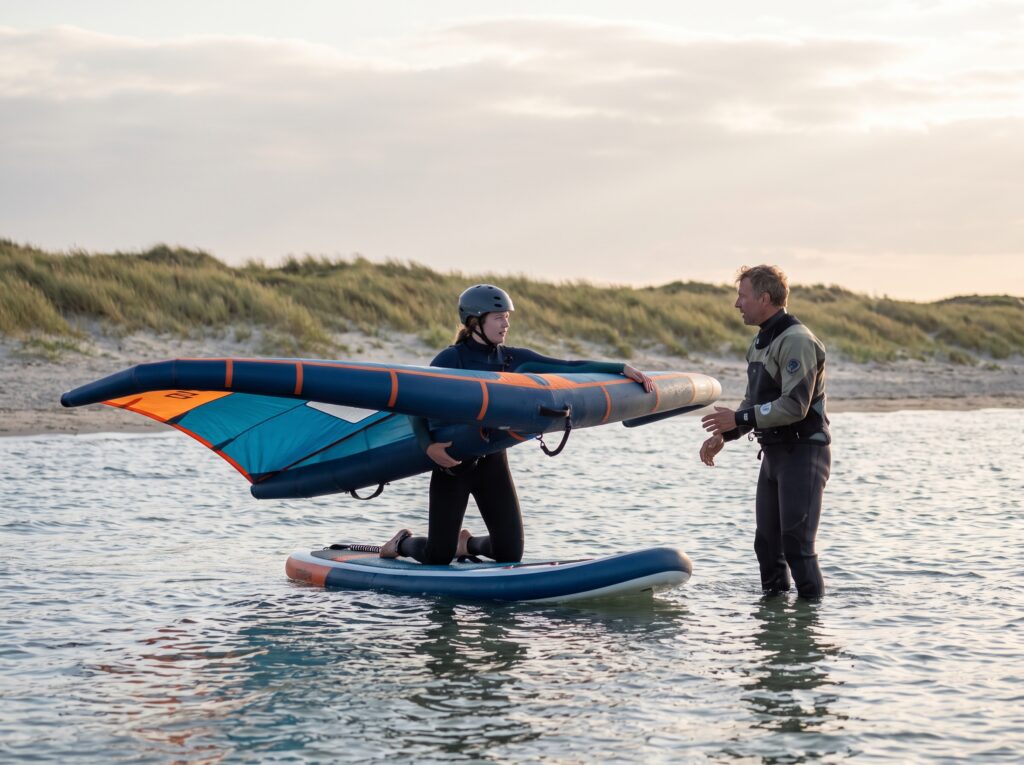
The fastest way into flying is not through buying gear, but through the first proper lessons. In a wingfoil course you ride the right set, learn the movements in the right order and afterwards buy with purpose instead of guessing expensively. A basic course gets you safely onto the water.
What does it all cost?
A complete wingfoil set (wing, board, foil) new usually comes to 2000 to 3500 euros. Used or as a last-year model you save significantly, especially on the board and wing. A course costs around 350 to 850 euros depending on spot and duration and is the best investment before you buy anything at all.
Saving tip: “I just want to try it out”
Before you buy, rent a set or take a taster or basic course at a school, that saves bad purchases and you find out whether the sport grabs you. If you then want to get started cheaply, one set, not three, is enough:
- A wing in your all-round size (see table), ideally new or barely used, because airtightness counts here.
- A large, beginner-friendly foil, used is fine, small foils come later.
- A high-volume board, as an inflatable or a used hardboard.
That way, buying used, you often land at around 800 to 1500 euros instead of 2000 to 3500 euros for everything new. When buying used, check the wing (seams and bladder), the mast (no play) and the board for dents.
Our tip for the start
As an average rider you are well set up with a 5-metre wing, a board around your weight plus 40 litres and a 2000-area foil, that easily covers 15 to 20 knots. Do the course first, then buy with purpose, and which day brings enough wind, the Wind Check tells you.
Note: As soon as our shop and partner links are live, you will find direct recommendations for wings, boards and foils here. Until then: the content stands on its own, even without a single click.