



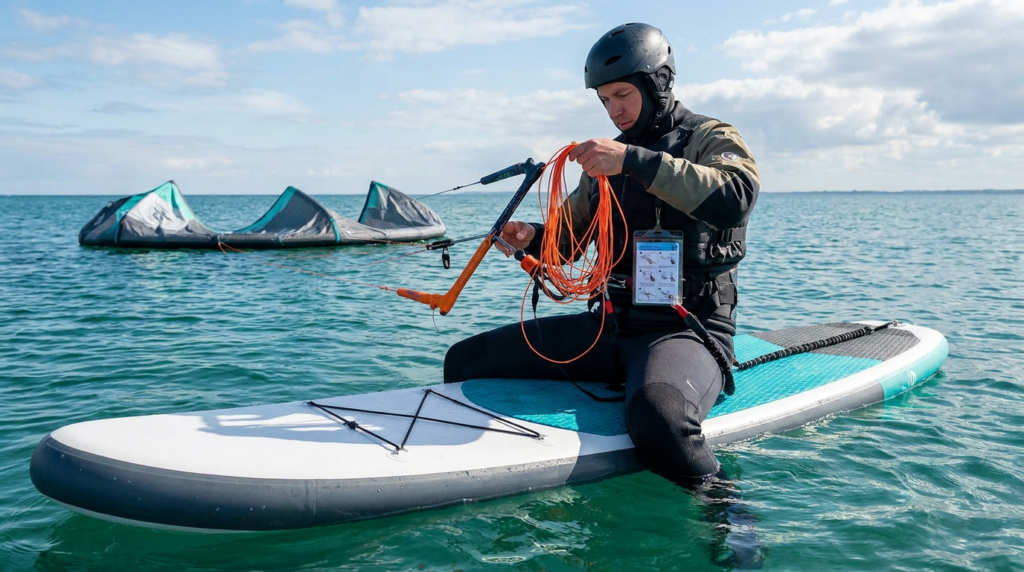
The self-rescue in kitesurfing is the single most important safety technique there is: you bring yourself back to shore on your own when the wind drops, gear fails or you are too far out. It sounds dramatic, but it is routine once you have learned it. Here comes the self-rescue explained calmly and step by step.
When you need the self-rescue
Typical situations: the wind drops and the kite no longer flies, a line breaks, or you have drifted too far from the beach. In all of these cases the rule is: do not panic. With kite and board you have enough buoyancy, time is on your side as long as you stay calm and work through it systematically.
Step 1: secure the kite and stay calm
Pull the depower fully and lay the kite onto the water in a controlled way. Take a breath. The kite floats, you float, nothing happens in a rush. Get an overview: where is the beach, what is the current doing, is the wind pushing you in a particular direction?
Step 2: wind up the lines
Pull yourself towards the kite along a front line, that is easier than swimming yourself. Once at the bar you wind the lines neatly onto the bar so nothing tangles. Clean winding is half of the self-rescue.
Step 3: bundle the kite into a float
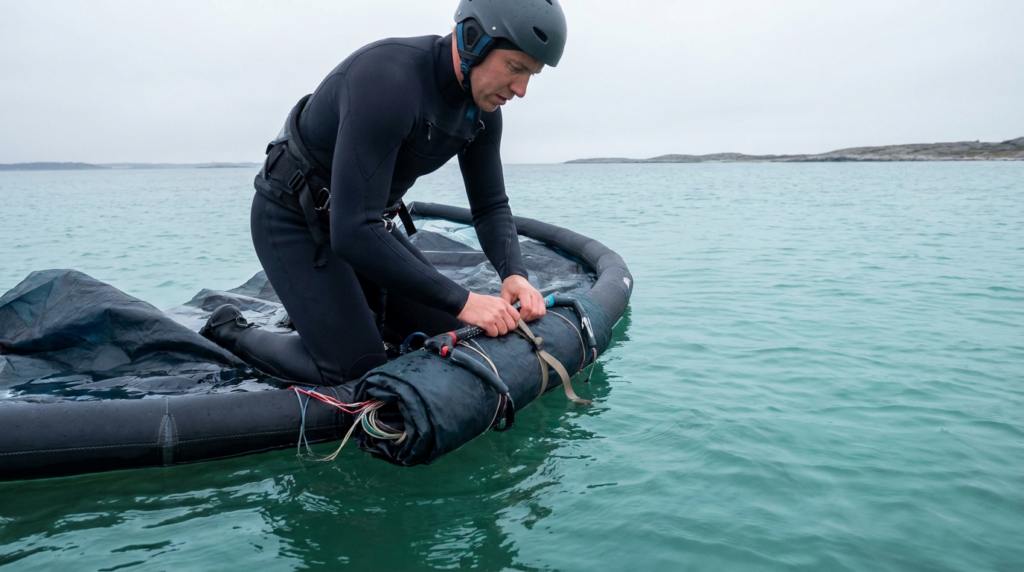
Now you roll the kite in from one side and hold it as a package. This turns the canopy into a float you can hold on to and drift with. In onshore wind the bundled kite often drifts you towards the beach already.
Step 4: back to shore
With the board under your arm and the bundled kite, you swim or drift calmly to the shore. If the wind helps you, you can even use the half-unrolled kite as a small sail. If you need help, give the internationally understood distress signal: one arm stretched above the head, waving several times. Save your strength, do not rush.

Practise before you need it
You do not learn the self-rescue in an emergency, but beforehand, calmly and in waist-deep water. That is exactly part of a good course, and on the shallow Baltic Sea spots you can practise it safely until it sticks. A basic course gives you safety from the start, and you will then already know the most common beginner mistakes too.